HubSpot AEO vs. Otterly: Platform or standalone tool?
Here’s the question most teams are actually trying to answer: do you need a standalone tool to monitor how your brand shows up in AI search, or do you need something that connects that monitoring to the content and CRM workflows that let you act on it?

本条来自 HubSpot Marketing Blog(marketing),聚焦 品牌营销、人工智能。 See exactly where your brand shows up in answer engines and take action to close AI visibility gaps.
Here’s the question most teams are actually trying to answer: do you need a standalone tool to monitor how your brand shows up in AI search, or do you need something that connects that monitoring to the content and CRM workflows that let you act on it
- HubSpot AEO vs. Otterly: Platform or standalone tool?
- HUBSPOT AEO TOOL
- HubSpot AEO vs. Otterly: How are they different?
- HubSpot AEO Tool
- See exactly where your brand shows up in answer engines and take action to close AI visibility gaps
Here’s the question most teams are actually trying to answer: do you need a standalone tool to monitor how your brand shows up in AI search, or do you need something that connects that monitoring to the content and CRM workflows that let you act on it
- Home
- Marketing
- HubSpot AEO vs. Otterly: Platform or standalone tool?
HubSpot AEO vs. Otterly: Platform or standalone tool?
HUBSPOT AEO TOOL
See exactly where your brand shows up in answer engines and take action to close AI visibility gaps.
Here’s the question most teams are actually trying to answer: do you need a standalone tool to monitor how your brand shows up in AI search, or do you need something that connects that monitoring to the content and CRM workflows that let you act on it?

That’s the real difference between HubSpot AEO and Otterly. Both track your visibility in AI engines like ChatGPT, Gemini, and Perplexity. But what happens after the data comes in is where they diverge.
HubSpot AEO is a CRM-connected AEO solution built directly into the HubSpot platform. It surfaces visibility insights and routes them into content creation, campaign management, and pipeline tracking, without requiring you to switch tools. Otterly is a standalone AEO monitoring tool that tracks your AI visibility, provides reporting, and lets you export data via Looker Studio, an API, or an MCP server.
If you’re trying to decide between them, here’s an honest breakdown.
- HubSpot AEO vs. Otterly: How are they different?
- HubSpot AEO vs. Otterly Features and Engines
- Which tool helps me act faster on insights?
- HubSpot AEO vs. Otterly Pricing and Capacity
- How Integrations and Workflows Compare for HubSpot Users
- AEO vs. SEO: Do I need both?
- What should I do first if I’m new to AEO?
- Frequently Asked Questions About HubSpot AEO vs. Otterly
HubSpot AEO vs. Otterly: How are they different?
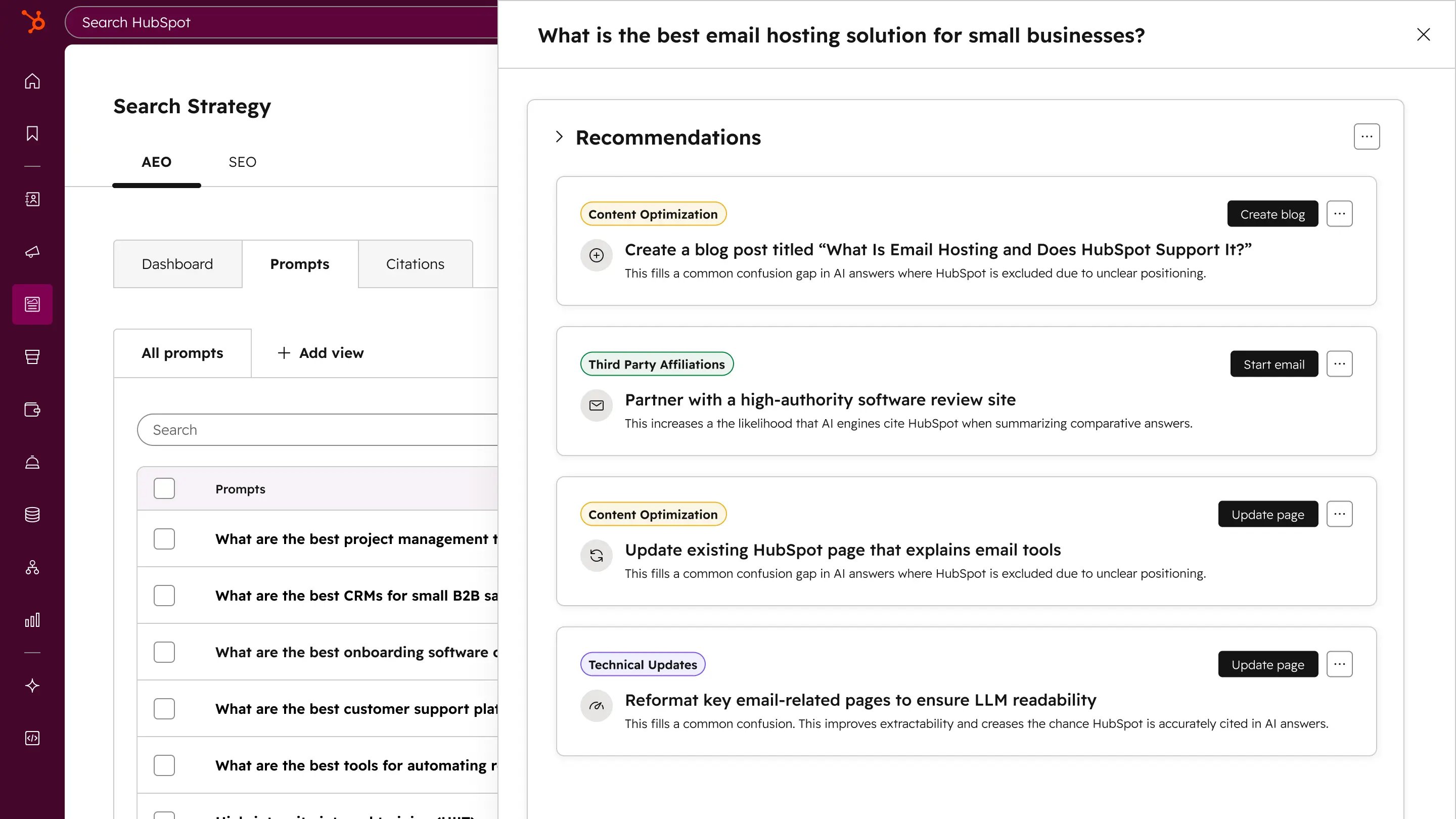
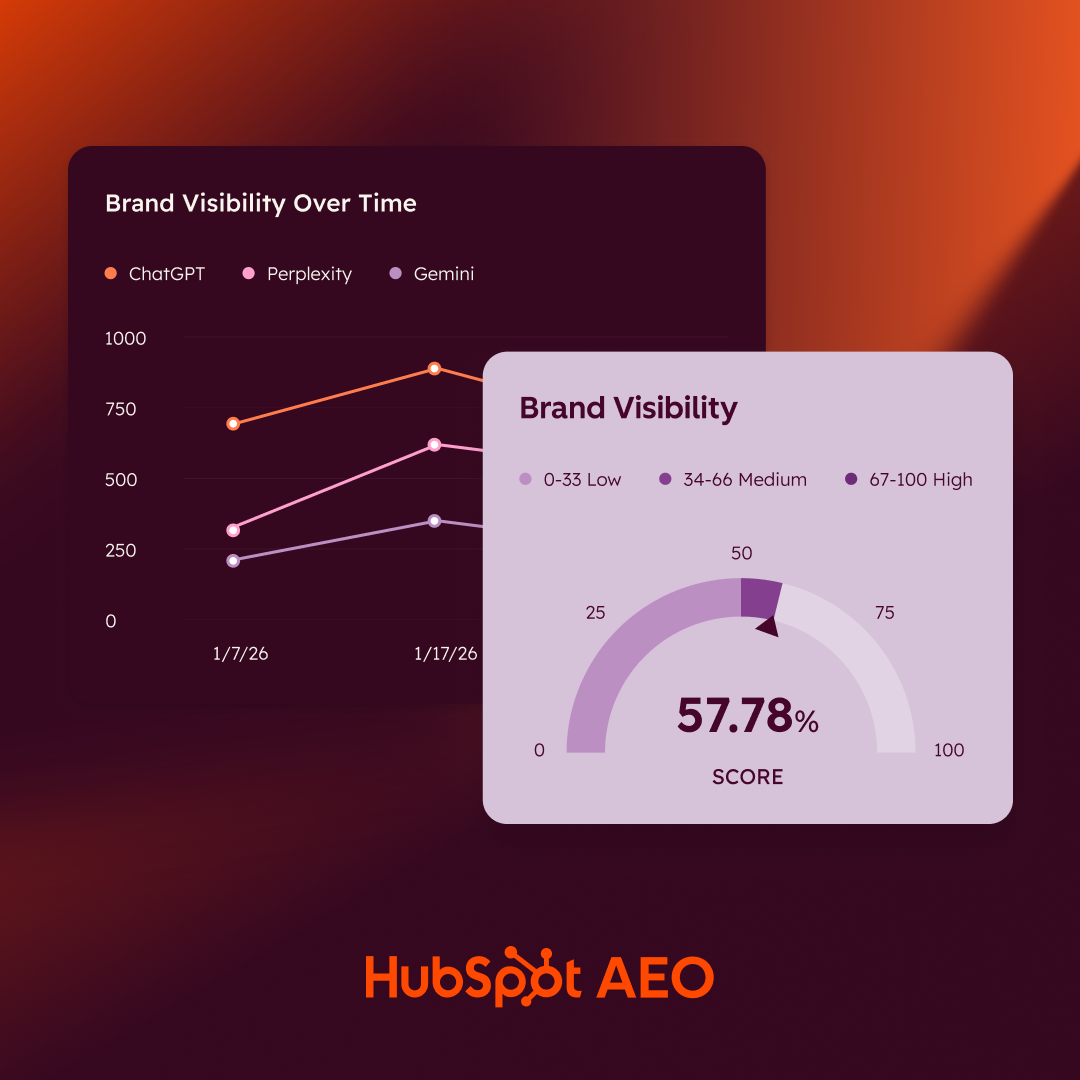
HubSpot AEO is built into the HubSpot platform. It tracks how your brand appears across ChatGPT, Gemini, and Perplexity, then connects those insights directly to your CRM data, marketing campaigns, and content tools.
When it surfaces a gap, you can publish a blog post, schedule a LinkedIn update, or engage on Reddit without leaving HubSpot. The prompt suggestions it gives you aren’t generic industry templates — they’re built from what it already knows about your company, competitors, and customers.
Otterly is a purpose-built content intelligence platform for AI search. It calls itself “neutral and objective,” tracking from a first-person perspective on a daily basis. It covers a wider range of AI engines out of the box (ChatGPT, Google AI Overviews, Google AI Mode, Perplexity, and Microsoft Copilot), with Google Gemini and Claude available as paid add-ons.
Otterly offers strong standalone reporting and integrates with Looker Studio, a public API, and an MCP server. What it doesn’t do is connect that data to a CRM, marketing automation, or content creation workflow — that part is up to you.
The core decision lens: if your team just needs AI visibility monitoring and has a separate content workflow you’re happy with, Otterly works. If you want AEO insights to flow directly into the tools where you create content, run campaigns, and track pipeline, HubSpot AEO is the stronger fit.
HubSpot AEO Tool
- Track AI mentions.
- Analyze citations
- Monitor prompts
- Benchmark competitors
HubSpot AEO vs. Otterly Features and Engines
Here’s a side-by-side look at what each tool actually does:
ChatGPT, Gemini, Perplexity
ChatGPT, Google AI Overviews, Google AI Mode, Perplexity, Microsoft Copilot (Gemini + Claude as add-ons)
Brand visibility score
Yes (Brand Visibility Index)
Share of voice / competitor tracking
Yes (Share of AI Voice)
Yes (-100 to +100 scale)
Yes (enthusiastic, caveated, or dismissed)
Yes (CRM-powered suggestions)
Yes (manual + Query Fan Out Tool)
Yes (weekly URL-level tracking)
Content audit / GEO score
Yes (Crawlability Checker + predictive GEO score)
Ad & sentiment tracking
Yes (ChatGPT Ads, Shopping cards, AI Overviews)
CRM-connected insights
Built-in content creation
Looker Studio integration
28 days (25 prompts)
Which prompts and citations will matter most for my team?
This is where the two tools take meaningfully different approaches.
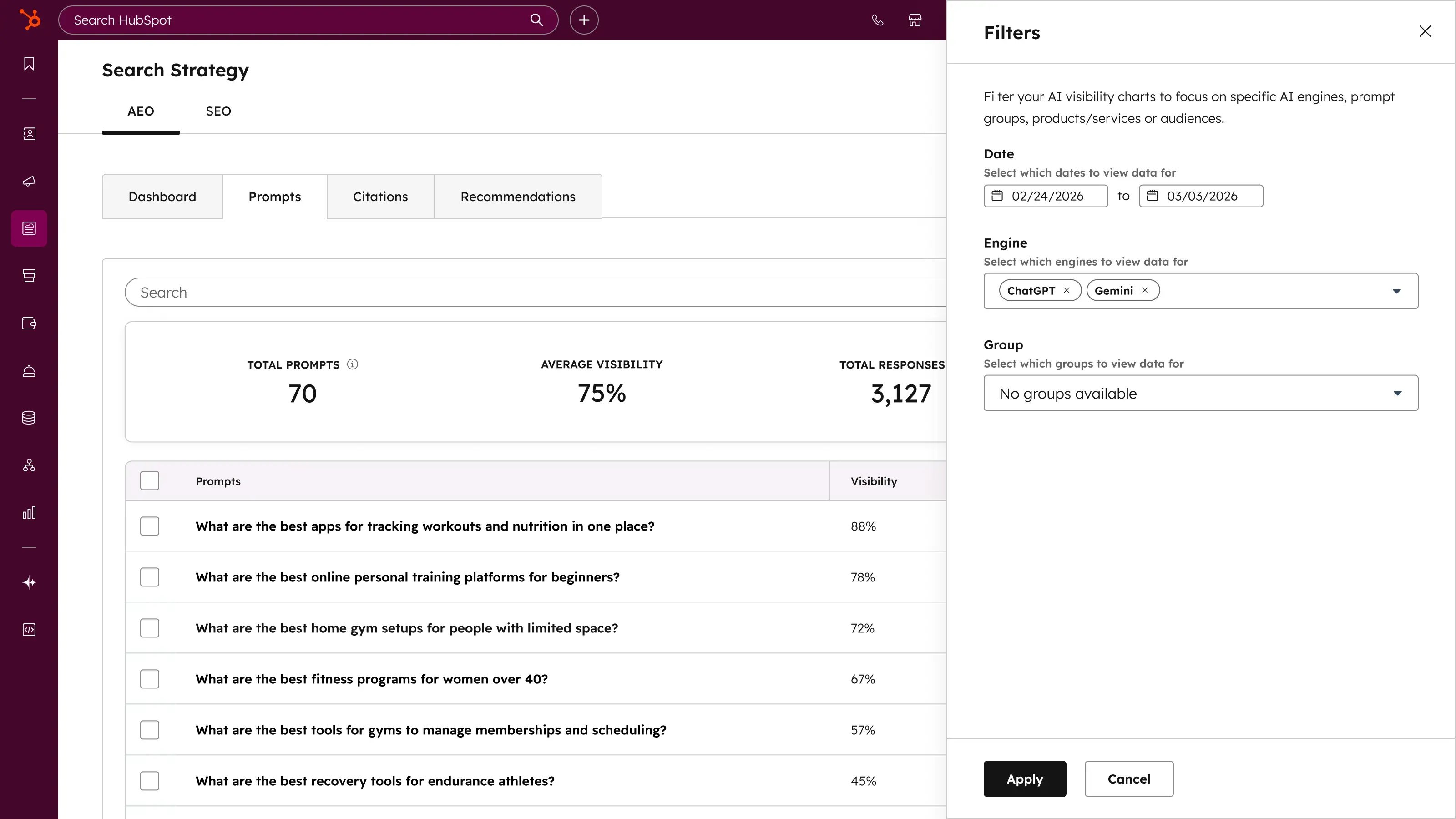
HubSpot AEO uses your CRM data to suggest prompts from the start. Because it knows your industry, competitors, and customer profile, the prompts it recommends tend to reflect actual buyer questions rather than generic category queries. You still pick the final set, but you’re not starting from a blank page.
Otterly’s Query Fan Out Tool takes a different approach: you give it a single user prompt, and it shows the full range of related queries an AI engine might generate from that starting point. This is useful for prompt discovery and gap analysis, especially if you’re building a prompt library from scratch or want to understand how far a topic branches.
For citation tracking, Otterly monitors domain citations and specific URLs weekly. HubSpot tracks which domains, pages, and content types are being cited in AI answers for your category, and lets you filter by source type (owned, competitor, third-party, social, affiliate) and content type (blog, news, product, social).
Pro tip: If you’re a HubSpot user, the prompt suggestions that come from your CRM data save real setup time.
How much guidance do I get beyond monitoring?
HubSpot AEO transforms visibility gaps into prioritized recommendations. You don’t have to interpret a dashboard and figure out what to do next — it tells you.
Otterly gives you a Content Audit with a predictive GEO score and actionable optimization tips, plus a Crawlability Checker to confirm AI bots can actually read your site. Those are useful diagnostic tools that HubSpot AEO doesn’t offer. But they stop at the recommendation level — executing on them happens outside Otterly.
Which tool helps me act faster on insights?
This is the clearest difference between the two tools.
With HubSpot AEO and Marketing Hub, when the data shows your brand isn’t showing up for a key prompt, you can write a blog post, schedule a social update, or engage on a third-party platform without leaving HubSpot. Your AEO data and campaign metrics live in the same place, so you can connect a visibility shift to the content that drove it.
With Otterly, you get the insight, go to your content tool, publish, then come back to Otterly later to see if it moved the needle. For some teams that workflow is fine. For others, the context-switching slows things down.
Best for workflow efficiency: HubSpot AEO, if your team already uses HubSpot for content or marketing. Otterly, if you want a monitoring layer that sits on top of your existing stack without changing how you work.
When should you automate after publishing?
If you’re already using HubSpot’s Marketing Hub or Content Hub, AEO data can connect directly to your automation workflows. When you publish content to close a visibility gap, you can trigger nurture sequences, update contact properties, or route leads based on what they were searching for in AI. That’s not a feature of AEO alone — it’s what happens when AEO lives inside a platform with CRM and automation already built in.
Otterly doesn’t offer this. It’s a monitoring and reporting tool, not a marketing automation platform. If you need to connect AEO insights to lead nurturing, you’d use Otterly’s API to pull data into whatever system you use for that. For more on how generative engine optimization fits into this picture, that’s worth reading alongside your tooling decision.
HubSpot AEO vs. Otterly Pricing and Capacity
HubSpot AEO Pricing
HubSpot AEO is available as a standalone tool at $50/month (or $45/month billed annually). The free trial runs 28 days and includes 25 prompts across ChatGPT, Gemini, and Perplexity — no credit card required.
If you want AEO built into your full marketing and content platform, HubSpot for Marketers (Marketing Hub + Content Hub + AEO) starts at $900/month.
HubSpot AEO Tool
- Track AI mentions.
- Analyze citations
- Monitor prompts
- Benchmark competitors
Otterly Pricing
Otterly offers a 7-day free trial, then three paid tiers:
- Lite — $29/month ($25/month annually): 15 search prompts, 4 base AI engines, daily tracking, 1,000 GEO URL audits/month, unlimited team members
- Standard — $189/month ($160/month annually): 100 search prompts, 5,000 GEO URL audits, Looker Studio Connector, public API (2,000 requests/month), MCP access
- Premium — $489/month ($422/month annually): 400 search prompts, 10,000 GEO URL audits, 5,000 API requests/month
- Enterprise — Custom pricing: SSO, quarterly GEO Health Check, dedicated Customer Success contact
Note that Otterly’s base plans don’t include Gemini or Claude tracking — those are add-ons. If you need coverage across all major engines, factor add-on costs into your total.
Otterly also offers an Agency Partner tier on Standard or Premium plans, which increases prompt limits (150 for Standard, 500 for Premium), adds unlimited workspace management, and includes white-labeled Looker Studio reports at no extra charge.
Capacity Planning
HubSpot AEO ($50/mo)
Otterly Lite ($29/mo)
Otterly Standard ($189/mo)
Not specified (25 in trial)
What this means in practice: For a small team that just needs to monitor 15 or fewer prompts across major AI engines, Otterly Lite at $29/month covers the basics. For a team that wants CRM-connected visibility and doesn’t need a high prompt volume, HubSpot AEO at $50/month includes the workflow integration that Otterly doesn’t offer at any tier. For teams that need 100+ prompts, URL auditing, and API access, Otterly Standard at $189/month adds depth that the standalone HubSpot AEO plan doesn’t match — though you’d be managing those insights in a separate workflow.
Explore HubSpot AEO →
How Integrations and Workflows Compare for HubSpot Users
本条目归入「Brand Marketing」垂直,涉及真实话题:品牌营销、人工智能。
· 市场:关注 品牌营销、人工智能 对相关品类与竞争格局的潜在影响。
· 消费者:受众行为与偏好变化值得追踪。
· 品牌:本动向对品牌资产建设的启示。
· 渠道:内容分发与触点组合(社媒 / 电商 / 线下)的协同值得复盘。
· 核心话题:品牌营销、人工智能。
· 可思考:如何把「品牌营销」的洞察,转化为可衡量的内容与增长动作?
面试中可引用「HubSpot AEO vs. Otterly: Platform or standalone tool?」:围绕 品牌营销、人工智能,说明你对行业动向的判断与可落地动作。
本条目相关英文术语可在「商务英语」模块按话题检索,用于外企面试表达训练。
See exactly where your brand shows up in answer engines and take action to close AI visibility gaps.…
HubSpot AEO is built into the HubSpot platform. It tracks how your brand appears across ChatGPT, Gemini, and Perplexity, then connects those insights directly to your CRM data, mar…
HubSpot AEO is a CRM-connected AEO solution built directly into the HubSpot platform. It surfaces visibility insights and routes them into content creation, campaign management, an…